
Article: Can DIY Glasses Have Prescription Lenses? What to Know Before You Make Your Own
Can DIY Glasses Have Prescription Lenses? What to Know Before You Make Your Own
Yes, DIY glasses can take prescription lenses, as long as the rim is grooved to hold a lens, the frame shape suits your prescription and your measurements are taken on the finished frame while you wear it. At our DIY eyewear workshop in Surry Hills, prescription lenses are available for the frame you make: you bring a current prescription or book an eye test, and the lenses are made for that frame and fitted to your face.
Why do people worry that handmade glasses won't work with a prescription?
If you wear glasses every day, a pair with plain lenses is a souvenir rather than something you will actually use. You like the idea of shaping your own frame, but you need to see through it at work, on the road and on your phone.
The worries are usually practical. Will a beginner's frame hold a lens securely? Will the lenses be thick and heavy because the shape is wrong for your numbers? Will your vision feel slightly off because something homemade can't be as accurate as a shop frame? People who wear multifocal glasses, also called progressive lenses, tend to worry most, because they already know how sensitive those lenses are to position.
Each of these has a clear technical answer, decided mostly by the shape you choose and how the finished frame is fitted.
What does a frame need before prescription lenses can go in?
A prescription lens is only accurate when it is held in the right place in front of your eye. That depends on four things the frame has to get right.
1. A rim that can hold a lens
A bevel is the V-shaped edge ground around a lens so it locks into a matching groove inside the frame rim. The groove in an acetate frame needs an even depth all the way around, and the rim needs enough thickness to carry it. In our workshop, bevelling is one of the technical steps we support you with, so the frame you make is built to accept a lens, not just to look like glasses.
2. A shape that suits your prescription
Lens thickness changes with frame shape. For short-sighted (minus) prescriptions the edges are thicker than the centre, so very large or wide shapes show more edge thickness. For long-sighted (plus) prescriptions the centre is thicker, and larger shapes make the whole lens bulkier. In our experience, the stronger your prescription, the more a moderate, well-proportioned eye shape helps the finished glasses look and feel lighter.
3. Lens centres that line up with your pupils
Pupillary distance (PD) is the distance between the centres of your two pupils. The optical centre is the point of a lens where light passes straight through without being bent sideways. When a frame is much wider than your PD, the optical centres have to be moved inwards from the middle of each lens opening, which can thicken one edge. Choosing a frame width close to your face width keeps this small.
4. Enough depth for multifocal glasses
Fitting height is the vertical distance from the bottom of the lens opening to the centre of your pupil while you look straight ahead. Progressive lenses need enough room below the pupil for the intermediate and reading zones. A very shallow shape can squeeze those zones, so if you wear multifocals we guide you towards a shape with suitable depth for your lens design.
A quick self-check you can do now: look at your current prescription. If it has an "ADD" value, you are prescribed extra reading power, which usually means multifocal or reading lenses. Mention this when you book, and bring your prescription on the day, so the shape you choose can be planned around it from the start.
What usually gets missed when lenses go into a self-made frame?
When people make frames at home or outside a practice, the frame itself is rarely the problem. The gaps tend to appear in the steps between the frame and the lenses.
- Measuring on the old glasses. PD and fitting height taken from a previous pair do not transfer reliably to a new shape.
- Measuring before the frame is adjusted. Pantoscopic tilt is the forward angle of the lenses when the frame sits on your face. Nose pad and temple adjustments change this angle and the lens position, so measurements should be taken after the basic fitting.
- Skipping the final fitting. A frame that slips or tilts moves the lens away from its measured position, and vision changes with it. This matters most with progressive lenses.
Which lens options can you choose for the frame you make?
Here is how the lens options work at our 1-Day Beginner's DIY Eyewear Making Class.
| Lens option | What you need | When your glasses are ready |
|---|---|---|
| Non-prescription blue light lenses | Nothing extra; included in the workshop fee | Ready for pick-up the following day, with a pre-booked 15-minute final fitting |
| Non-prescription polarised sunglasses lenses | Nothing extra; included in the workshop fee | Ready for pick-up the following day, with a pre-booked 15-minute final fitting |
| Prescription single vision lenses | Your current prescription, or an eye test with us | About one week |
| Prescription progressive lenses | Your current prescription, or an eye test with us | About two weeks |
How does our workshop handle prescription lenses in DIY glasses, step by step?
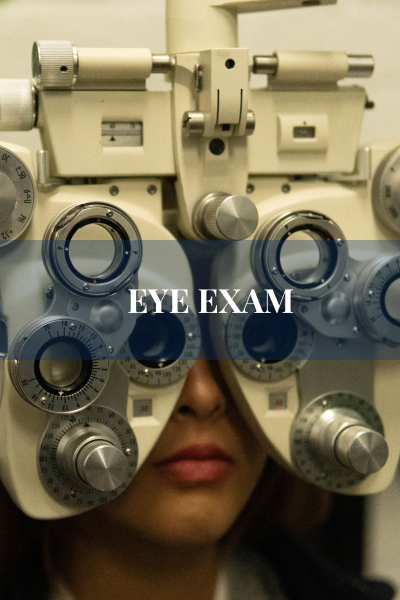
- Prepare your prescription. Bring your current prescription, or book a comprehensive eye examination with our optometrists at Lunettes Art Lab. Medicare-covered eye tests can be arranged separately, and the eye test and workshop may happen on different days. A comprehensive eye examination with us includes our Personalised Vision Scan, using Rodenstock DNEye biometric eye measurement and STEPPER OPTI AI visual behaviour assessment, at no additional charge.
- Choose a shape and acetate with your lenses in mind. You choose from a curated range of frame shapes, acetate colours and two stainless steel temple finishes with spring hinges. If you are wearing prescription lenses, we talk through how the shape will suit your numbers.
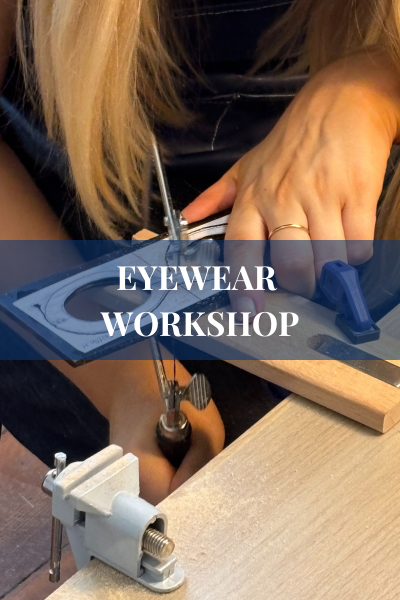
- Make your frame. You hand-cut the frame front with a saw, then file, sand and polish it. We support you with the technical steps such as bevelling, shaping the frame and installing the temples and nose pads.
- Fit the frame to your face. Following our Lunettes Fittingology method, the frame is aligned and the nose pads and temples are adjusted so it sits evenly. Your lens measurements are then based on the frame you made, sitting where it will actually sit.
- Lenses are made for your frame. Expected turnaround is about one week for single vision lenses and about two weeks for progressive lenses.
- Final fitting. Collect your glasses at a pre-booked 15-minute fitting session, where we check the fit, make final adjustments and confirm the frame stays stable with a gentle pull test.
Frequently Asked Questions
Can a beginner's frame really hold a strong prescription?
In our experience, yes, provided the rim is grooved properly and the shape suits the prescription. Strong prescriptions depend more on shape choice than on skill level. A moderate eye size and a frame width close to your face usually give a lighter-looking result with thicker lenses.
Can I put progressive lenses in glasses I make myself?
Yes, progressive lenses are available for workshop frames, with an expected turnaround of about two weeks. The frame needs enough depth below your pupil for the reading zone, so let us know you wear multifocals before you choose your shape. The final fitting is especially important for progressives, because small shifts in position change how the zones line up with your eyes.
Do I need a new eye test before the workshop?
If you have a current prescription you are happy with, you can bring it with you. If you are unsure whether it is still accurate, you can book a comprehensive eye examination with our optometrists, which may be on a different day from the workshop. If you notice sudden vision changes, eye pain, flashes or new floaters, see an optometrist or GP promptly rather than waiting for a workshop date.
For why the final adjustment matters as much as the lenses, read Part 1 of our Lunettes Fittingology series: Do Glasses Need to Be Fitted?
Join Our DIY Eyewear Making Workshop
If you have held back from making your own glasses because you need a prescription, you can plan for it from the start and leave with a frame you will wear every day. Our 1-Day Beginner's DIY Eyewear Making Class in Surry Hills walks you through each step, from cutting the front to the final fitting.
Book your DIY Eyewear Making Workshop
Already wearing glasses that don't sit comfortably? Book a complimentary 15-minute Signature Fitting with us.
Lunettes Art Lab
- Address: 249 Riley Street, Surry Hills NSW 2010, Sydney
- Phone: (02) 8385 4996
- Website: lunettesartlab.com
- Book a complimentary 15-minute Signature Fitting: book online
- Book a comprehensive eye examination: book online

Written by Ricky Lim