




Why Do My New Glasses Make the Floor Look Curved?
When new glasses make the floor look curved or tilted, it is usually a perception effect: the new lenses bend and magnify the image slightly differently from your old pair, and your brain has not yet recalibrated. For most people it settles with steady wear over a week or two. If it does not ease, the cause is often in how the lenses were made or positioned.
Part 1 of our Right Prescription, Wrong Feeling series, on glasses that test correctly but still feel wrong to wear.
Key takeaways
- A curved floor in new glasses is usually lens distortion or a prescription change, and it disappears when the glasses come off.
- It should ease steadily over one to two weeks of consistent wear. If it does not, have the glasses checked.
- Lens centring, base curve and frame tilt all affect how flat the world looks.
Why do new glasses make the floor look curved?
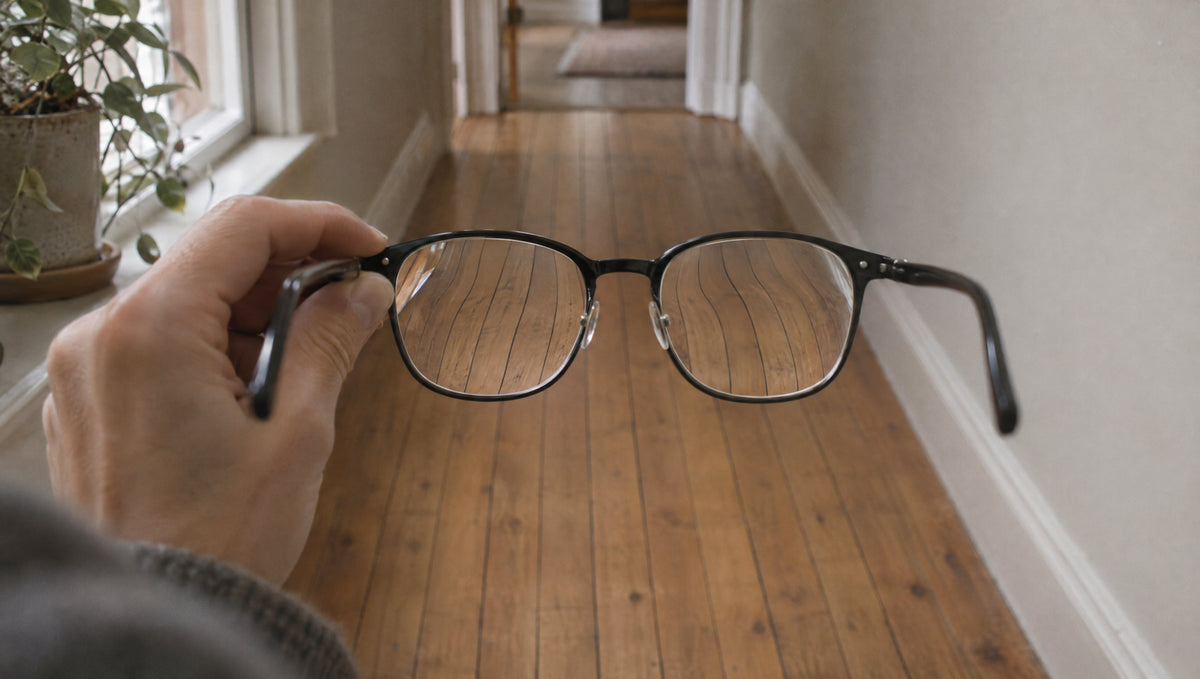
You collect your new glasses, walk to the door and the floor seems to rise towards you. Tiles look slightly bowl-shaped, and a door frame leans as you turn your head.
Take the glasses off and everything is flat again. It is unsettling on stairs, and it is a common complaint with new glasses.
What causes the floor to look curved or tilted in new glasses?
Every spectacle lens slightly changes the size and shape of what you see. Your brain had learned your old pair, so a new pair feels wrong until it adapts.
Distortion is the uneven bending of an image as it passes through a lens. It is strongest towards the edges, which is why straight lines curve as your eyes move off centre.
| Cause | What you tend to notice | Settles with wear? |
|---|---|---|
| New or changed astigmatism correction | Floor slopes, door frames lean | Often, over one to two weeks |
| Stronger prescription | Floor looks closer or further away | Often |
| Different base curve from your old lenses | A bowl effect towards the edges | Sometimes |
| Lenses not centred on your pupils | A pulling feeling, one-sided tilt | Rarely; it needs correcting |
| Frame tilted too much or too little | Floor swims when you look down | Rarely; it needs adjusting |
Base curve is the curvature of the front surface of a lens. A change of base curve between pairs alone can make familiar rooms look different.
A simple self-check: look straight ahead through the centre of the lenses and turn your head rather than your eyes. If the floor looks flat through the centre and only bends towards the edges, it is most likely ordinary adaptation. If it tilts even through the centre, have the glasses checked.
What usually gets missed?
A correct prescription can still feel wrong if the lens is not sitting where it was measured to sit. A frame that has slipped, tilts to one side or sits further from the eyes changes the distortion you see.
We cover the related symptom of dizziness in why new glasses can make you dizzy.
How do we solve a curved floor in new glasses?
At Lunettes Art Lab in Surry Hills, we treat a curved floor as a problem to trace, not simply something to wait out.
- Compare. We ask when the distortion appears and compare your new glasses with your previous pair.
- Check the measurements. We confirm each lens centre lines up with your pupil at the right height.
- Check the fit. We look at frame tilt, the distance from lens to eye and whether the frame sits level.
- Look at the eye itself. A comprehensive eye examination by our optometrists includes the Personalised Vision Scan: Rodenstock DNEye biometric measurement and the Behavioural Eye Movement Scan, so lenses can be designed around your own eyes.
- Refit or remake. Lenses are edged in our in-house lab, so repositioning or remaking a lens stays in one place.
If a curved view comes with sudden vision change, eye pain, flashes or new floaters, see an optometrist or GP promptly rather than waiting.
Frequently Asked Questions
How long does it take for the floor to look normal with new glasses?
For most people it eases steadily over one to two weeks of consistent wear. What matters is that it keeps improving.
Should I switch back to my old glasses when the floor looks curved?
Switching back and forth tends to slow adaptation, because your brain keeps relearning both pairs. Wear the new pair consistently and take care on stairs.
Can a curved floor mean my prescription is wrong?
It can, but it more often comes from a normal prescription change, a different lens curve or a lens sitting away from its measured position.
Next in the series: Part 2 looks at why new glasses can make everything look smaller or larger than it really is.
Book Your Eye Examination and Personalised Vision Scan
If your new glasses still make the floor look curved after a fair period of wear, an eye examination with the Personalised Vision Scan helps us find whether the cause is the prescription, the lens design or how the lens sits in front of your eye. Our optometrists check your vision and eye health, and the scan measures how your eyes are built and how you use them.
Book a Comprehensive Eye Examination
What we do differently
- Comprehensive eye examinations are carried out by our optometrists, with the Personalised Vision Scan (Rodenstock DNEye biometric measurement and the Behavioural Eye Movement Scan) included at no additional charge.
- Lenses are edged in our own in-house lab, and facial measurements are taken for lens positioning.
- We work as problem solvers for glasses that do not feel or see right, rather than starting from a product to sell.
What you gain, and what it costs to leave it
When the cause is found, you can wear glasses that look clear and feel steady, so stairs, kerbs and screens stop demanding your attention. If the cause is a lens out of position or an unsuitable lens design, the distortion often does not fade with time, and a new pair can end up left in a drawer.
If your glasses have moved since collection, a complimentary 15-minute Signature Fitting can put the lenses back where they were measured to sit.
Lunettes Art Lab
- Address: 249 Riley Street, Surry Hills NSW 2010, Sydney
- Phone: (02) 8385 4996
- Website: lunettesartlab.com
- Eye examination and Personalised Vision Scan: book online

Written by Ricky Lim