Why Is My Vision Worse in Dim Light Even With Glasses?
Your vision often gets worse in dim light, even with glasses, because your pupils widen in the dark. A wider pupil lets light in through more of the lens and more of your eye, so small optical errors that stay hidden in daylight start to show as blur, glare and halos. An up-to-date prescription and lenses designed around your pupil size can make a real difference.
Key takeaways
- Bigger pupils at night expose small optical errors.
- A tiny prescription change can feel much bigger after dark.
- Sudden changes in night vision need an optometrist promptly.
Why does everything look sharp at lunch and soft at dinner?
In a bright office your glasses feel perfect. Then you walk out at dusk, read a dim menu or drive home in the rain, and street signs blur. Headlights grow streaks. You lean closer to everything.
It is not your glasses failing. It is your eyes changing with the light.
What changes in your eyes when the light drops?
Your pupil is the opening at the front of your eye that controls how much light gets in. In bright light it shrinks. In the dark it opens wide.
A small pupil works like a camera on a small aperture: it hides minor focusing errors. A wide pupil uses more of the eye's optics, so tiny irregularities show up. Higher-order aberrations are those subtle irregularities beyond the basic prescription, and they are a common reason lights look smeared at night.
| Cause | What you notice | What can help |
|---|---|---|
| Small prescription change | Slight blur, mainly at night | An updated eye examination |
| Wide pupils | Halos and streaks around lights | Lenses designed around your pupil size |
| Dirty or scratched lenses | Glare and haze | Cleaning, coatings or new lenses |
| Frame sitting out of place | Blur when looking through lens edges | A frame fitting |
Quick tip: clean your lenses before night driving, inside and out. A thin film of skin oil spreads light into glare far more than you would expect.
What usually gets missed?
Most prescriptions are measured in a bright room, when your pupils are small. Your night-time eye is a different eye. If lens design never considers how your pupil behaves in dim light, your glasses are tuned for daytime only.
How do we look at dim-light vision?
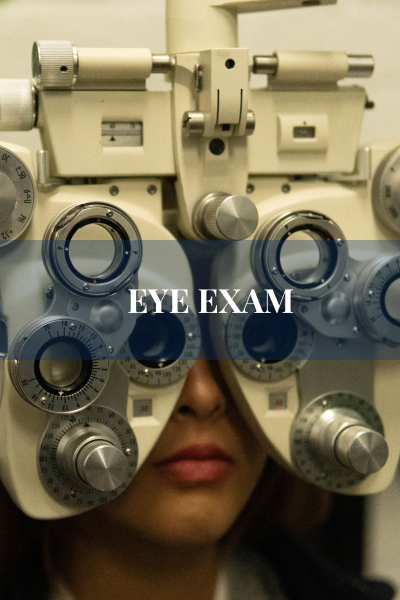
- Our optometrist checks your prescription and eye health in a comprehensive eye examination.
- The Rodenstock DNEye biometric scan measures your eye in detail, including how your pupil responds in bright and dim light.
- We fit your frame so the lens sits where it was measured.
- Your lenses are designed using those measurements rather than an average eye.
The Personalised Vision Scan is included at no additional charge with a comprehensive eye examination by our optometrists.
Frequently Asked Questions
Is worse night vision normal with age?
Some change is common, but it should be checked. Conditions such as cataract can also affect night vision, and only an eye examination can tell the difference.
Do yellow night driving glasses help?
Tinted lenses reduce the light reaching your eye, which is the opposite of what you need in the dark. Speak with your optometrist before using them.
When should I worry?
See an optometrist or GP promptly for sudden vision change, eye pain, flashes or new floaters.
Related reading: Why Do Two People With the Same Prescription Need Different Lenses?
Book Your Eye Examination and Personalised Vision Scan
If evenings and night driving feel harder than they used to, start with a proper check. Our eye examination and scan look at how your eyes behave when the light drops.
Book a comprehensive eye examination
Just want your frame checked? Book a complimentary 15-minute Signature Fitting.
Lunettes Art Lab
- Address: 249 Riley Street, Surry Hills NSW 2010, Sydney
- Phone: (02) 8385 4996
- Website: lunettesartlab.com
- Book a complimentary 15-minute Signature Fitting: book online
- Book a comprehensive eye examination: book online

Written by Ricky Lim