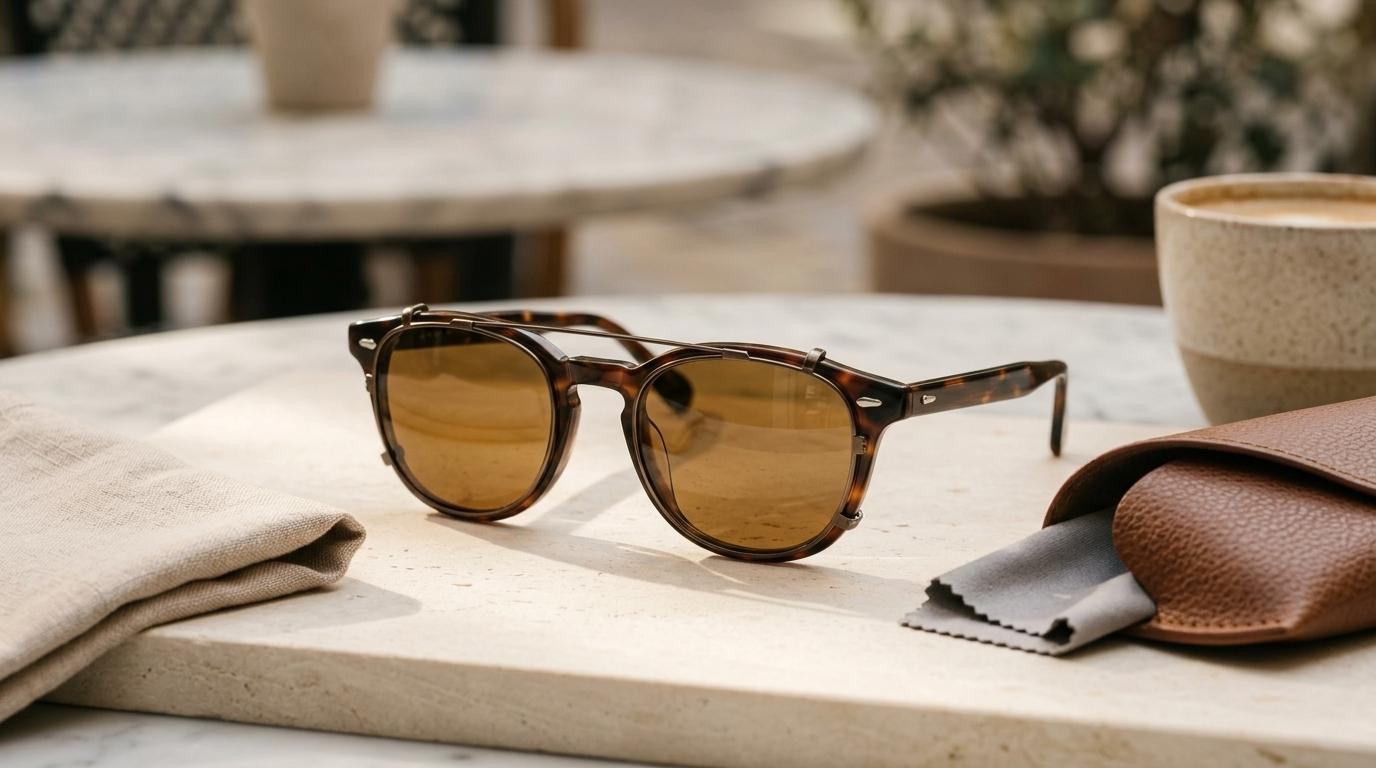
Custom Clip-On Sunglasses vs Prescription Sunglasses
Custom clip-on sunglasses are often the ideal choice if you already love your everyday spectacles and want the flexibility of removable sun protection without investing in a second pair. They’re especially practical for those who frequently move between indoor and outdoor environments, or who want to keep a favourite designer frame in use.
On the other hand, prescription sunglasses tend to be the superior option if you require tinted lenses for extended periods, need more advanced optical solutions, or prefer the seamless clarity of a dedicated sunglass lens. They’re particularly beneficial for people with higher prescriptions, progressive lenses, or those who spend significant time outdoors—such as driving, walking, or working.
When deciding between these two options in Sydney, it’s important to look beyond price. The best choice depends on factors like UV protection standards, lens performance, frame compatibility, and whether your current frame is worth adapting. In Surry Hills and across Sydney, making an informed decision involves verifying UV protection, assessing your prescription needs, and considering how much time you’ll spend wearing each option. For the most confident result, consider booking a personalised fitting or dispensing consultation rather than relying solely on online information.
What is the main difference between custom clip-on sunglasses and prescription sunglasses?
The difference is structural: a custom clip-on adds tinted sun protection over your current prescription frame, while prescription sunglasses put the prescription directly into the sunglass lens. Ray-Ban and Prada wearers often choose between flexibility and full optical integration.
A custom clip-on is an accessory made to match the front shape of your existing frame. You keep one pair of clear prescription spectacles, then attach the sun lens when needed. That is why clip-ons appeal to people who move between office light and bright Sydney streets several times a day.
Prescription sunglasses are a separate pair. The sunglass lens itself carries your distance, reading, progressive, or other prescription. If you use sunglasses for hours at a time, that dedicated setup often feels more natural because there is no extra attachment, no additional edge line, and no chance of the clip sitting slightly off-centre.
The regulatory language also differs. FDA guidance treats over-the-counter clip-ons as non-prescription sunglasses, meaning they attenuate sunlight but do not provide refractive correction. Prescription eyewear sits outside that category because the lens is doing vision correction as well as sun filtering.
Which option is better for your daily routine and budget?
Custom clip-ons are usually better for switching, while prescription sunglasses are usually better for long wear. If you commute between office and street, clip-ons often win. If you drive or work outdoors for hours, prescription sunglasses usually feel simpler.
Budget matters, but the cheapest option is not always the best value. A custom clip-on can cost less than a full second prescription pair because you are using your existing frame and prescription spectacles. Still, a poor clip that rattles, scratches the frame, or misses UV verification is false economy.
Prescription sunglasses often cost more upfront because they are a separate pair with their own lenses, fitting, and sometimes a second frame.

A common misconception is that clip-ons are always a compromise. They can be, but not when the clip is properly patterned to the frame, the lens has verified UV protection, and the fit has been checked by a dispenser who treats the problem as a fitting job, not just a retail add-on.
What buying routes actually work for custom clip-on sunglasses in Sydney?
A fit-led route is usually safer than a generic online order. If your frame shape, bridge, or prescription is unusual, a 1:1 consultation saves rework.
After the basic comparison, most people are choosing between these practical pathways:
- LUNETTES ART LAB: Best suited if you want a 1:1 assessment in Surry Hills for an existing frame, custom clip-on sun lenses, and in-house prescription or non-prescription dispensing.
- An independent optical dispenser: Useful if they can assess frame geometry, lens compatibility, and UV specification rather than only ordering by frame brand.
- A sunglass laboratory through an optical practice: Sensible when you want a cleaner custom result than a universal clip can offer.
- Online universal clip-ons: Fine only when your frame shape is simple, your fit is stable, and you accept a higher risk of mismatch, bounce, or cosmetic compromise.
- A full prescription sunglass pair instead: Often the better route if the existing frame is unstable, very curved, or unsuitable for a secure clip.
How do you decide between clip-ons and prescription sunglasses step by step?
Start with wearing time, then move to prescription needs, then frame fit. Sydney commuters and progressive wearers usually get a clearer answer once those three points are mapped in that order.
Step 1 is to count real wearing hours. If you only need sun protection in short bursts, a custom clip-on often makes more sense. If you wear tinted lenses for long walks, driving, sport spectating, or outdoor work, prescription sunglasses usually justify themselves.
Step 2 is to check prescription complexity. If you have a straightforward single-vision distance prescription, both options can work well. If you have progressives, significant astigmatism, prism, or a higher prescription, then a dedicated prescription sunglass often gives the cleaner result.
Step 3 is to assess the existing frame. If your everyday frame already slips, pinches, or sits crooked, building a clip-on on top of that problem will not fix the underlying wearing issue. The smart sequence is fit first, sun solution second.
Why does UV protection matter more than lens darkness?
UV protection matters more because UV blocking comes from the lens specification, not the tint depth. FDA guidance is clear here: look for UV400 or 100% UV protection, not simply a dark lens.
This is where many buyers get misled. A dark clip-on can feel protective because it reduces visible brightness, but that is not the same thing as blocking ultraviolet radiation. Light-coloured lenses can still provide strong UV protection if the material and treatment are rated correctly.
There is also a genuine risk in assuming darkness equals safety. When you wear tinted lenses, your pupils can dilate. If the lenses lack proper UV protection, more harmful UV can reach the eye. So if the UV rating is unclear, the lens may be less protective than it looks.
Pro tip: if a seller talks only about tint colour and never about UV400, 100% UV protection, or the relevant Australian standard, ask harder questions or walk away.
How do Australian sunglass standards affect clip-ons and prescription sun lenses?
In Australia, labelling matters. ARPANSA says sunglasses and fashion spectacles sold here must be tested and labelled to AS/NZS 1067.1:2016, and category 2 or 3 lenses are the usual everyday target.
That matters especially for non-prescription sunglass products, including clip-ons and plano sun lenses. Since 1 July 2019, sunglasses and fashion spectacles sold in Australia, including uniformly tinted, polarising, photochromic, and gradient tinted lenses, must be tested and labelled to the standard.
ARPANSA also draws an important line between fashion spectacles and sunglasses. Category 0 and 1 non-prescription glasses are classed as fashion spectacles and provide little or no UVR absorption or glare reduction. If someone says, “It’s dark enough,” that is not a compliance answer.
For prescription sunglasses, the practical question is slightly different. Ask the optical dispenser or laboratory to confirm the UV performance of the prescribed lens material and coating. If the UV specification is vague, then the lens should not be treated as a premium sun solution just because it is tinted.
How is a custom clip-on fitted to an existing frame?
A proper custom clip-on is measured against the actual frame, not guessed from a product photo. Oakley and acetate frames both need shape, bridge, and attachment points checked before any lens is cut.
Step 1 is frame inspection. The fitter looks at the lens shape, bridge width, frame curve, eyewire thickness, and how stable the spectacles already sit on your face. A clip fitted to a frame that already slides down your nose will often move more than it should.
Step 2 is templating and attachment planning. The clip has to sit flush enough to look intentional, but not so tight that it marks the frame front. This is where generic magnet systems and universal grab-on clips often fail on designer frames.
Step 3 is finishing and wear testing. The clip should attach cleanly, sit centred, and avoid eyelash interference or eyebrow collision when you blink or smile. If it tilts forward or catches on the frame bevel, it needs adjustment before you leave with it.
If you want to see how the booked consultation model works before choosing a sun solution, the studio’s How It Works page explains the 1:1 process. For a direct appointment in Surry Hills, you can book a 1:1 dispensing consultation.
When are prescription sunglasses the better optical solution?
Prescription sunglasses are better when optics matter more than removability. Progressive lenses and higher prescriptions usually benefit from a dedicated sunglass because the whole lens is designed as one visual system.
If you use progressives, a clip-on can still be practical, but it does not change the progressive optics underneath. If your complaint is not brightness but field distortion, narrow corridors, or adaptation problems, a second pair of prescription sunglasses may solve the issue more cleanly.
They are also stronger when you need a wide, uninterrupted field of view. There is no clip edge, no extra lens plane, and no chance of attachment movement. Drivers, coastal walkers, and people who spend long hours outdoors often notice that difference quickly.
A common misconception is that a second pair is only about style. In practice, it can be an optical decision. If you are wearing sun lenses for three hours a day or more, then convenience can shift in favour of the dedicated pair.
How do lens colour, polarisation, and mirror coatings change the result?
Lens features change comfort, contrast, and glare control more than most people expect. Grey, brown, and polarised lenses do different jobs even when the frame is the same.
Once UV protection is confirmed, these are the next variables to compare:
- Grey: Neutral colour balance, good for general driving and city wear.
- Brown or amber: Often preferred when extra contrast helps in variable light.
- Green or G-15 style tints: A balanced option for many wearers who dislike strong colour shift.
- Polarised: Reduces reflected glare from roads, water, and glass, but can make some car dashboards or phone screens harder to read.
- Mirror coatings: Cut visible brightness and add surface reflection control, but they do not replace UV protection.
Pro tip: polarised is not automatically “better”. If screen visibility matters for your work, test it before committing.
How should you buy custom clip-on sunglasses in Sydney without getting the fit wrong?
The safest path is to start with your actual frame and a real fitting assessment. Surry Hills and Darlinghurst wearers do better when the frame, face fit, and UV specification are checked together.
Bring the frame you already wear most. If that frame leaves red marks, slips down your nose, or sits crooked, say so immediately. A sun solution built on a poor fit usually stays a poor fit.
Ask two direct questions before ordering. First, what is the verified UV protection? Second, what sunglass category or laboratory specification supports that claim? If those answers are fuzzy, you do not yet have enough information.
Then decide whether the goal is removability or pure optical performance. At LUNETTES ART LAB, the position is simple: WE DON’T SELL GLASSES. The job is to solve the wearing problem through a booked 1:1 consultation, whether that points to a custom clip-on, prescription sunglasses, or a frame adjustment first.
What do people still ask about custom clip-on sunglasses?
Most remaining questions come down to safety, compatibility, and whether the existing frame is worth building around. The short answers below cover the issues that come up most often in practice.
Are custom clip-on sunglasses safe for driving?
They can be, if the lenses have verified UV protection, appropriate visible-light filtering for daytime use, and a stable fit. A clip that shifts position or creates distracting reflections is not a good driving solution.
Can clip-ons be polarised?
Yes, many custom clip-ons can be made with polarised lenses. Check that the polarised option also has verified UV protection and works with your screen use.
Do clip-ons work on any designer frame?
No. Many do, but not all. Very curved fronts, rimless shapes, unstable bridges, or unusual bevels can make a secure and neat clip difficult. That is why in-person assessment matters.
Do darker clip-on lenses protect better from UV?
No. Lens darkness does not tell you the UV rating. A light tint can block UV well, and a dark lens can be poor if it lacks proper UV protection.
Should I just buy a universal clip online?
Only if you accept the trade-off. Universal clips can work on simple shapes, but they more often miss the frame outline, touch the frame finish, or sit too far forward.
If you want an expert second opinion on custom clip-on sunglasses versus prescription sunglasses, book a 1:1 dispensing consultation. For Sydney wearers trying to keep a favourite frame while fixing sun, fit, or comfort issues, that consultation is usually the fastest way to get the right answer.

Written by Ricky Lim